
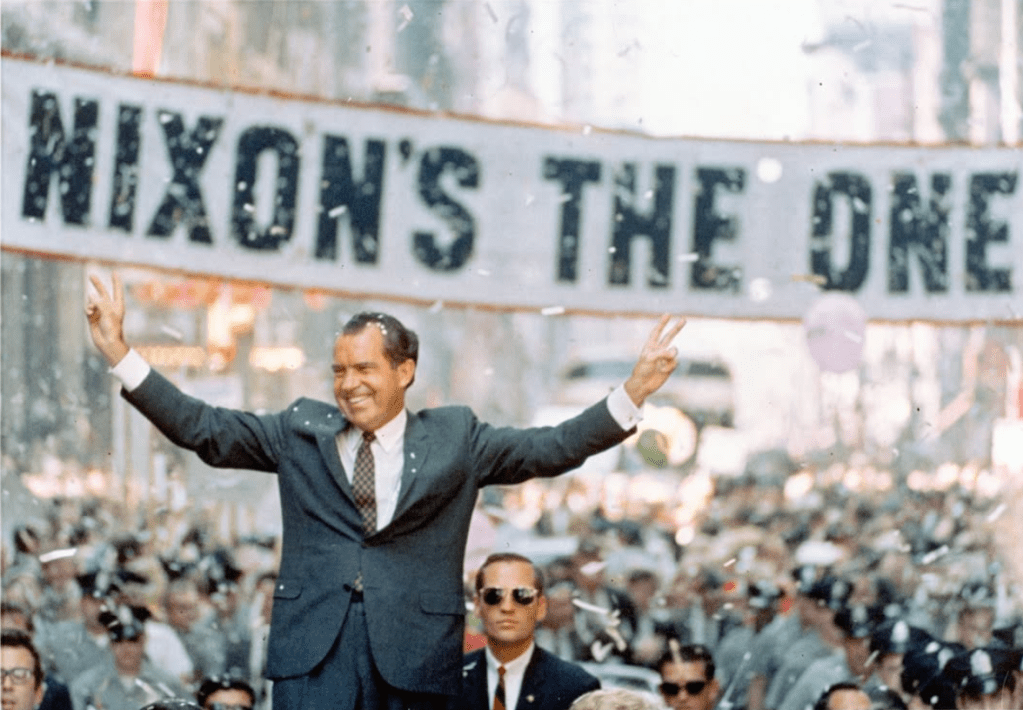
5th November 1968
Richard Nixon was elected 37th President of the United States. Nixon-Agnew carried 32 states and received 301 electoral votes in a three-way race with incumbent Vice President Hubert Humphrey and former Alabama Governor George Wallace. (Image: 1968 election campaign WHPO-0866-01)
🇬🇧 United Kingdom
While November 5, 1968, did not feature a singular dominating news story in the UK, several notable events were reported in the national press during that period:
1. Ongoing Discussions on Race Relations
The UK Parliament was engaged in debates over the Race Relations Bill, which aimed to address racial discrimination in housing, employment, and public services. This legislation was part of broader efforts to promote racial equality in the country. (Wikipedia)
2. Economic and Industrial Updates
Reports covered various economic indicators and industrial developments, including discussions on inflation rates, employment figures, and trade union activities. These topics were of significant interest amid the UK’s ongoing economic challenges.
3. Cultural and Entertainment News
The entertainment sections highlighted upcoming theatrical productions, musical performances, and film releases. Notably, there was anticipation for the release of The Beatles’ self-titled album, commonly known as the “White Album,” later in November.
🇺🇸 United States
1. Nixon Elected President
The primary headline across U.S. newspapers was the election of former Vice President Richard Nixon as the 37th President of the United States. He narrowly defeated Democratic candidate Vice President Hubert H. Humphrey and American Independent Party candidate George Wallace. Although the popular vote was close, with Nixon securing 31,783,783 votes to Humphrey’s 31,271,839, Nixon achieved a decisive electoral vote count of 301 to Humphrey’s 191. The outcome remained uncertain until the following day due to delayed results from key states like Illinois. (Wikipedia)
2. Paris Peace Talks Postponed
The Paris Peace Talks, aimed at ending the Vietnam War, were scheduled to commence on November 6. However, they were called off less than 24 hours before their planned start. The Viet Cong negotiator, Nguyen Thi Binh, announced a series of demands deemed unacceptable by South Vietnam, leading to the postponement. (Wikipedia)
3. Shirley Chisholm Makes History
In a groundbreaking achievement, Shirley Chisholm of Brooklyn, New York, became the first African-American woman elected to the United States Congress. She defeated James Farmer, a prominent civil rights leader and candidate for New York’s Liberal Party. (Wikipedia)
On November 5, 1968, significant events unfolded across various regions, reflecting the global turbulence of the era. Here’s an overview of major news stories from France, Germany, the Middle East, the Far East, and other parts of the world:
🇩🇪 Germany
Student Movements and Political Activism
In West Germany, the student movement was gaining momentum, fueled by opposition to the Vietnam War and calls for educational reforms. The attempted assassination of student leader Rudi Dutschke in April had intensified protests, leading to ongoing demonstrations and debates about democratic reforms. (Wikipedia)
🇫🇷 France
Aftermath of May 1968 Protests
Although the peak of the civil unrest occurred in May 1968, its effects were still resonating in November. The massive student and worker protests had challenged the government, leading to political and social reforms. By November, discussions continued around the implications of these events on French society and politics. (Wikipedia, ISReview)
🌍 Middle East
War of Attrition Between Egypt and Israel
Following the Six-Day War in 1967, tensions remained high between Egypt and Israel. By November 1968, the War of Attrition was ongoing, characterized by sporadic clashes and artillery exchanges along the Suez Canal, as Egypt sought to reclaim territory lost in the previous conflict. (Al Jazeera)
🌏 Far East
Vietnam War and Regional Tensions
The Vietnam War continued to dominate news in the Far East. The Tet Offensive earlier in the year had shifted public perception, and by November, discussions were ongoing about peace talks and the potential for U.S. withdrawal. Additionally, regional tensions persisted, with countries like China and the Soviet Union monitoring the situation closely.(HISTORY)
🌐 Rest of the World
Global Reflections on U.S. Presidential Election
The election of Richard Nixon as President of the United States was a major international story. Countries worldwide analyzed the potential implications of his leadership on global affairs, including the Vietnam War, Cold War dynamics, and international diplomacy.
 paul c-t